What Does the Future of Experience Actually Look Like? Here's What Four Experts Said at PwC
Time to read: 5 minutes
I'll be honest with you. When someone says "future of experience" at a meetup, my first instinct is to brace myself for a PowerPoint with a lot of circles, some overlapping, and the word "ecosystem" somewhere in the middle.
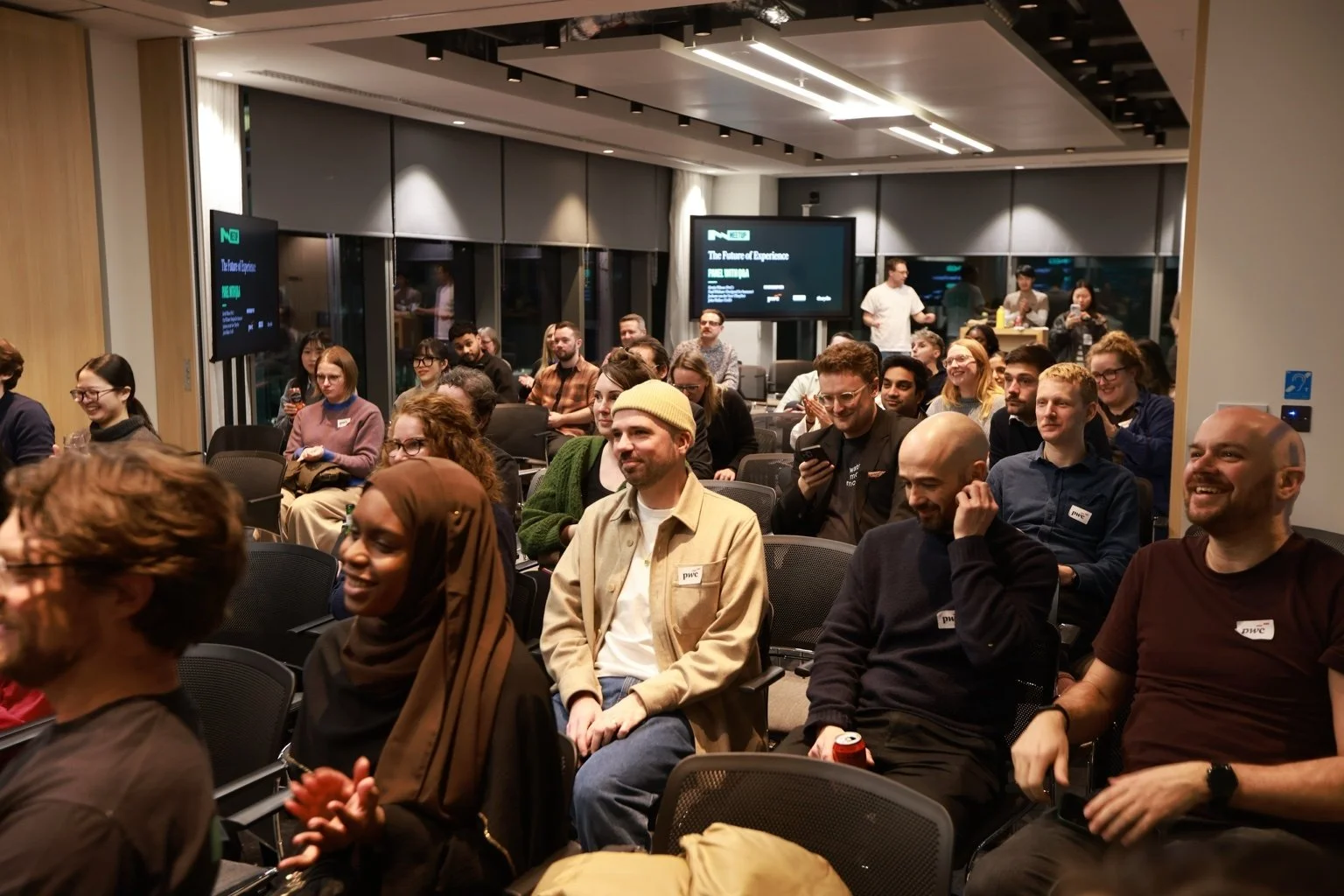
Last night at PwC in Manchester was different.
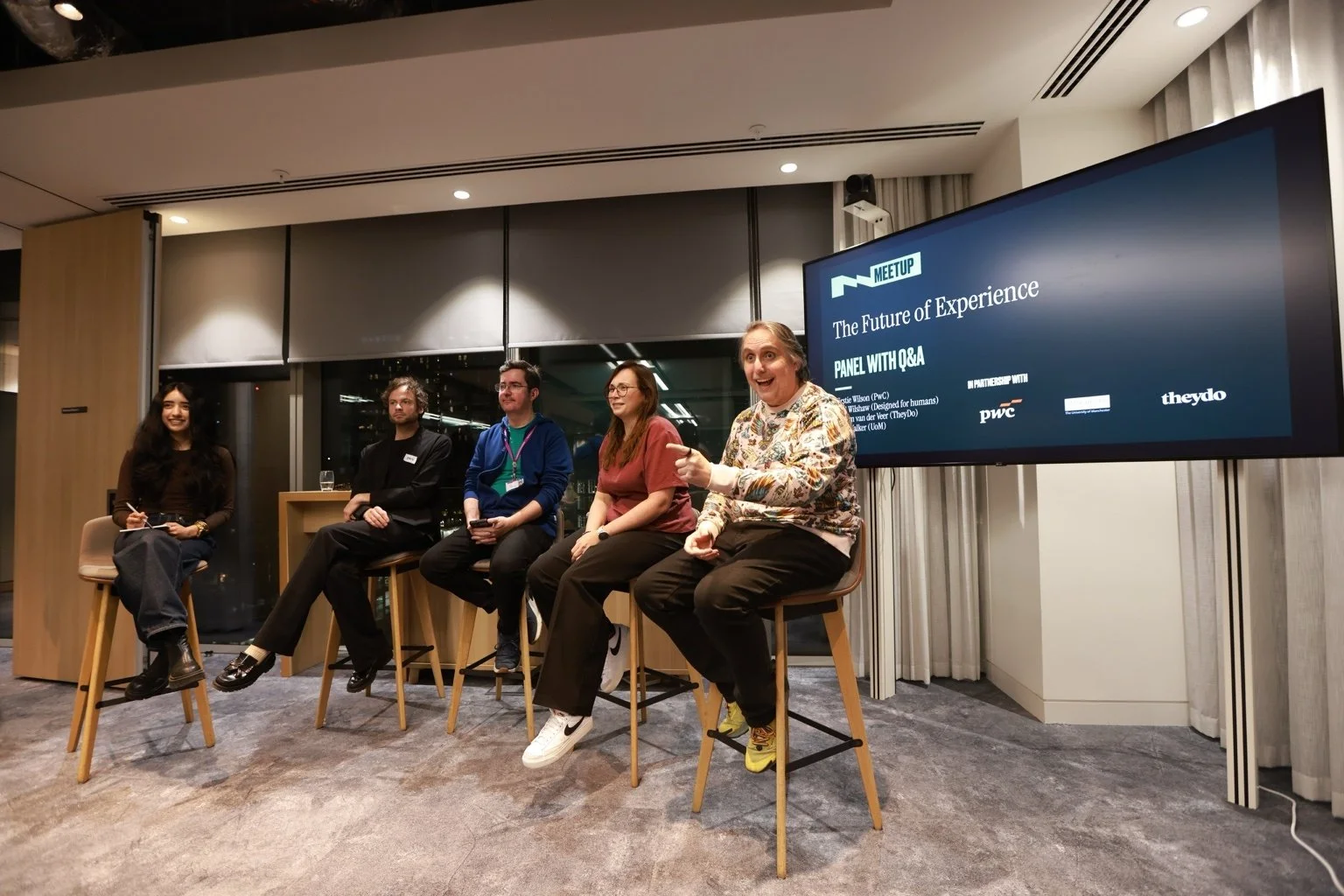
The Future of Experience panel — a Natter event hosted in partnership with PwC, the University of Manchester, and TheyDo — brought together four practitioners with genuinely different perspectives: Kirstie Wilson from PwC's experience design team, Jochem van der Veer, Co-founder and CEO of TheyDo, John Walker from the University of Manchester, and me, Paul Wilshaw, founder of Designed for Humans. Neeha Arfat held the whole thing together as host, which is harder than it looks when you've got four opinionated people and a room full of even more opinionated questions.
We sat on high stools. We talked about big things. Some of us gestured a lot. And apparently I said something about glitter and turds that made it into the official Natter write-up, which feels like a personal milestone. Here's what actually came out of it.
The biggest disruption? It's not the one you think.
The first question was blunt: what's the single biggest disruption shaping experience today?
My answer: it's not AI. It's the collapse of patience.
People have always wanted good experiences. But the gap between what's possible and what organisations actually deliver has never been more visible. AI has made that gap embarrassing. You can now spin up a prototype in an afternoon that does something a legacy enterprise system has failed to do for a decade. Users know this. They've stopped being forgiving.
The disruption isn't the technology. It's the expectation reset that comes with it.
Which brings me to the glitter. There's a temptation in organisations — and I've sat in enough boardrooms to have witnessed it many times — to throw a shiny new AI feature, a sleek interface, or a rebrand at a product that fundamentally doesn't work. You can't polish your way out of a broken journey. Sprinkling glitter on a turd does not solve the problem. It just produces a glittery turd. And your users will notice immediately.
Jochem made the point that organisations are drowning in data but starving for clarity. Journeys are fragmented across teams, tools and intentions — and no one person holds the full picture. AI amplifies this. It moves faster than the structures built to steer it.
Kirstie and John both pointed to the cultural dimension: experience isn't a discipline, it's a disposition. Organisations that treat it as a project or a department will always be playing catch-up with those that treat it as a way of thinking.
The role of practitioners in five years
This is where it got interesting — and slightly uncomfortable, in the best way.
The question asked how the role of experience practitioners would evolve. My take: AI is a superpower, if you actually pick it up.
Here's what I mean by that. I can now connect Figma via MCP to Claude and generate working prototypes in the time it used to take to write a brief. That's not a party trick — that's hours of refinement cycles gone. That's the miscommunication between design and engineering, gone. That's the endless back-and-forth where a developer builds something subtly different from what the designer intended, and a product manager signs off on something neither of them actually wanted — gone.
What that frees up is the thing AI genuinely cannot do: the ability to articulate and communicate across teams and disciplines. To stand in a room with an engineer, a product manager, a CFO, and a frustrated user, and translate between all four of them fluently. To make the case not just that good design is the right thing to do, but that it's directly connected to the company's profitability. Because it is. They are paying your salary, after all.
The practitioners who will thrive are the ones who use AI to remove the friction from delivery and spend the time they save on building alignment. Not more wireframes. More shared understanding.
Jochem talked about journey management as a framework for this — giving teams a shared language and a shared view of the customer so that decisions don't happen in silos. Which, when you think about it, is exactly the kind of systemic thinking that no amount of individual design craft can replace.
John brought in the education lens: are we training the next generation of practitioners for the job that exists today, or the one they'll actually be doing? (Worth asking yourself that question about your own team, by the way.)
Measuring what actually matters
This is the question that separates the people who care about experience from the people who care about looking like they care about experience.
Most organisations still measure what's easy to measure. Page load times. Task completion. NPS — bless its cotton socks. These things tell you something. They don't tell you enough.
The signals I think we should be paying far more attention to are behavioural: what are people doing when they think no one's watching? Where do they drop off, not because the journey broke, but because they lost confidence? Where do they call the helpdesk not because something went wrong, but because something wasn't clear enough?
Accessibility is a massive signal here, and massively underused. The workarounds users create to navigate around inaccessible experiences are some of the most valuable UX research you're not doing. If 20% of your users have a disability and your product doesn't account for that, you're not just failing those users — you're generating noise in your data that's masking where the real problems are.
The panel agreed that measurement needs to grow up. That means connecting experience metrics to business outcomes — not loosely, not "there's probably a relationship there," but specifically, causally, with a story that a CFO can follow.
The one thing to take away
Every panellist got a closing reflection. Mine was this:
Stop designing for the ideal user in ideal conditions.
Most experience design assumes someone with a reliable internet connection, 20/20 vision, plenty of time, and no particular stress. That person exists. They are not most of your users.
Design for the edges. Design for the person in a hurry on a cracked phone screen. Design for the person who's never done this before and is slightly scared of getting it wrong. Design for the person whose first language isn't English. When you design for those people well, you've almost certainly designed something brilliant for everyone else too.
Accessibility isn't a box to tick. It's a design philosophy. And it's the fastest route to genuinely excellent experience.
Thank you to Neeha Arfat for hosting with real warmth and keeping four very opinionated people moving, to the Natter team for putting together yet another properly good evening, to PwC for the venue, to Jack Roberts for an excellent presentation on growth through experience — you can read the full report here and it's worth your time — and to Kirstie, Jochem and John for a genuinely energising conversation.
If you want to keep the conversation going — whether about design systems, AI-powered experience tools, or why accessibility is actually your competitive advantage — find me at designedforhumans.tech or come and say hello on LinkedIn.
Paul Wilshaw is the founder of Designed for Humans. He builds design systems, leads experience teams, and genuinely believes good design should work for everybody.
Further reading
Explore our UX and UI services to raise clarity across your product

See how we ship product changes with pace and inclusion

Get practical comms that support clear UX
Read our guidance on the European Accessibility Act

Free consultation
We partner with you to identify pitfalls and help you to correct them, helping you increase customers and make more sales.
Double-click to edit...