What TEDx Manchester Taught Me About Listening, Living, and Letting Go of Your To-Do List
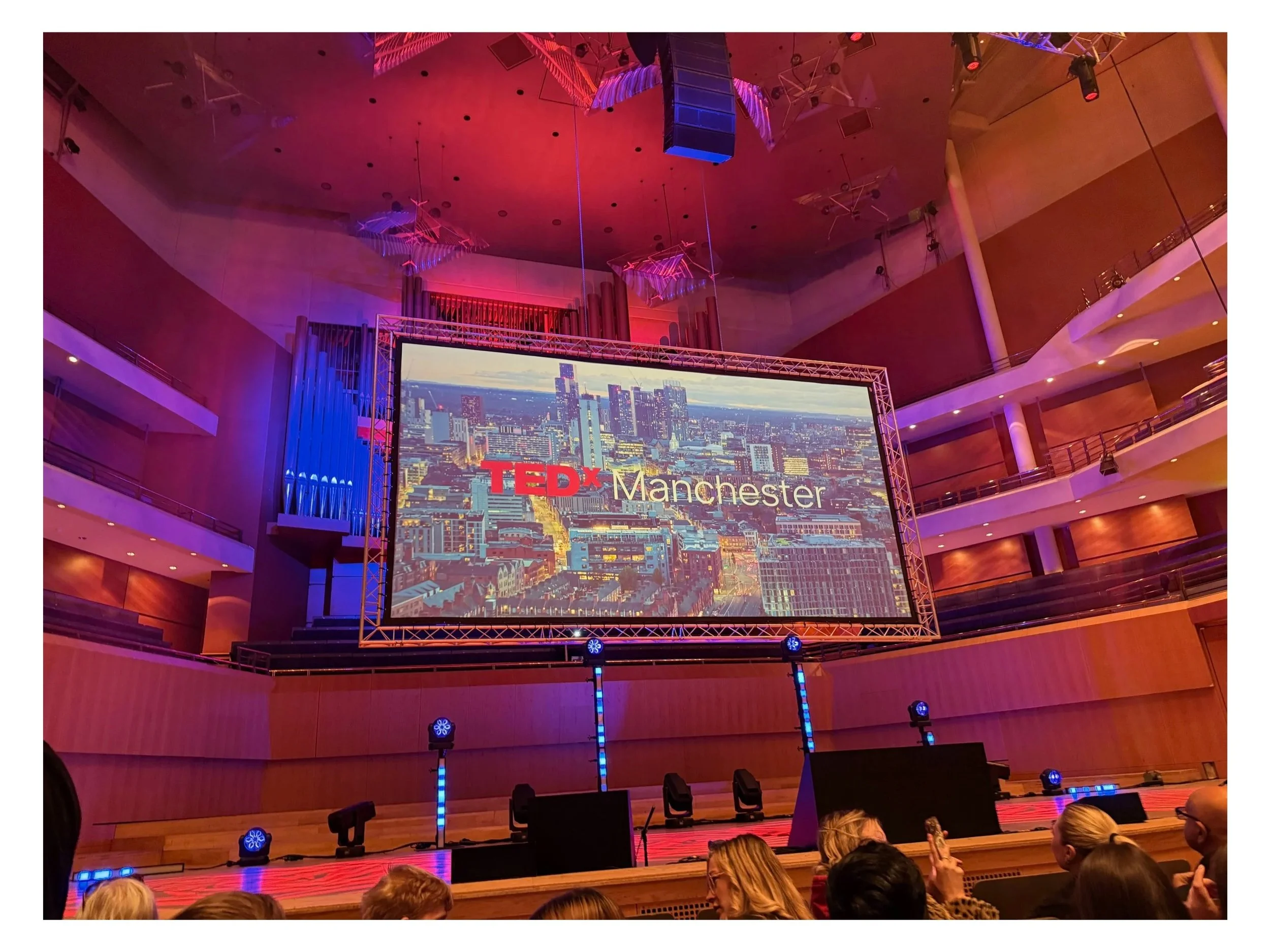
Seven hours. Ten speakers.
Five ideas worth paying attention to.
Time to read: 7 minutes
TLDR
TEDxManchester 2026 brought together ten speakers across topics from neuroscience to AI to ancient history. The thread running through all of them: most of us are sleepwalking through choices we didn’t consciously make, in environments engineered to distract us. This is a write-up of the five talks that landed hardest.
Last Saturday, I took Ted to TEDx Manchester 2026 at The Bridgewater Hall.
Seven hours. Ten speakers. A genuinely world-class stage. One very large screen, multiple moments that made me want to reach for a notebook, and at least one slide that made me look sideways at my phone with what I can only describe as mild shame.
A quick nod to Blake Mill — and particularly Ken Price — for sponsoring the event. It takes real commitment to back something like this, and it shows.
Here’s some highlights.
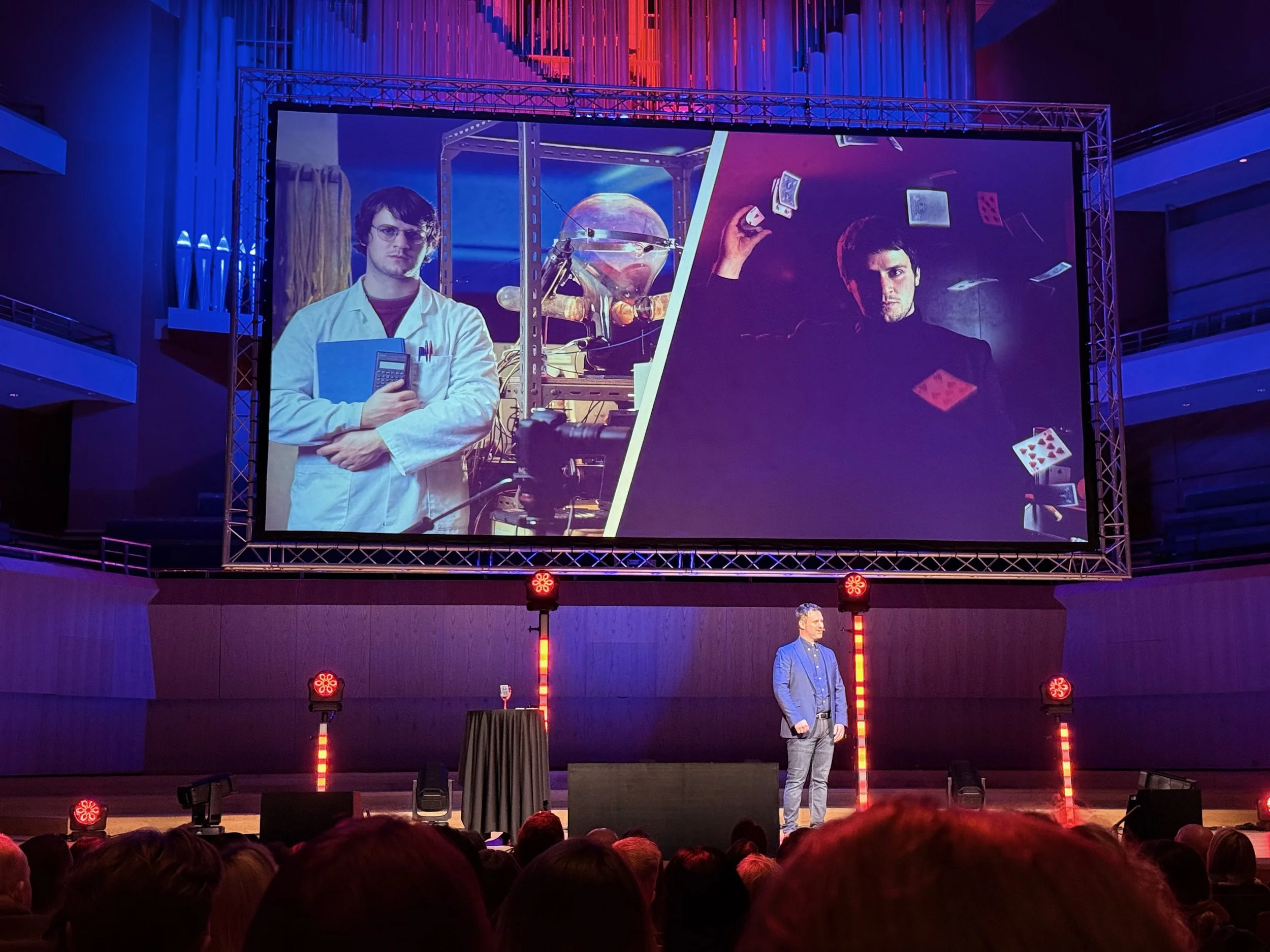
Kevin Quantum at TEDx Manchester
Kevin Quantum — The career U-turn nobody told you was allowed
Kevin opened the day and set the tone immediately. His talk centred on his own career change story — including appearing on Channel 4’s Faking It — and the idea that identity isn’t fixed. That you can deliberately immerse yourself in new networks, new disciplines, new worlds, and actually become someone different.
For someone like me who’s spent years at the intersection of design, technology, and business leadership — and who regularly has conversations with people who feel stuck — this landed. Not in a motivational poster way. In a “this is genuinely how change actually works” way.
You don’t transform by reading about transformation. You do it by surrounding yourself with the people you want to become. You borrow their lens. You pick up their vocabulary. You get comfortable being the least experienced person in the room for a while.
That’s not a soft skill. That’s strategy.
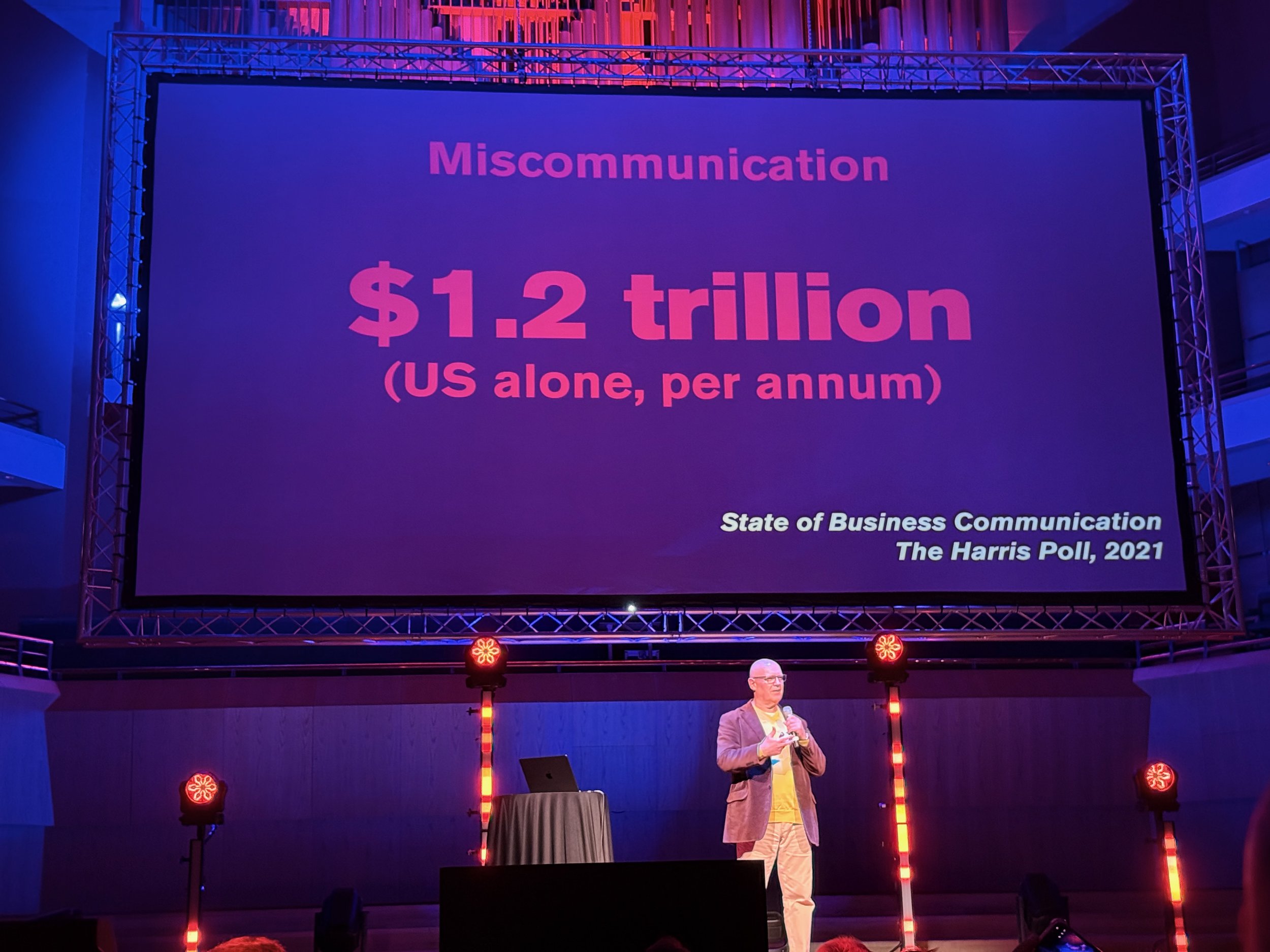
Julian Treasure at TEDx Manchester
Julian Treasure — $1.2 trillion worth of “Sorry, what?”
Julian Treasure is the reason I now feel vaguely embarrassed about how I listen.
His talk on sound and communication included a stat that stopped the room: miscommunication costs US businesses $1.2 trillion every single year. Per year. That’s not a typo. That’s not a rounding error. That’s just what happens when people talk at each other instead of listening.
The thing that made this relevant beyond “interesting conference fact” is that Julian wasn’t talking about the big dramatic miscommunications. He was talking about the quiet, everyday ones. The half-listened-to briefing. The meeting where everyone nodded but nobody was actually present. The message that was technically clear but tonally a disaster.
I work with teams and businesses on design and digital experience. And honestly? So much of what goes wrong in those contexts isn’t a design problem. It’s a listening problem. People are building solutions to problems they half-heard, for users they’ve only skimmed, with stakeholders who are only barely paying attention.
If your organisation is leaving money on the table, check whether anyone is actually listening to each other first. The design can wait.
TJ Power at TEDx Manchester
TJ Power — Your phone is a theme park designed to break you
This was the one that made me look sideways at my phone.
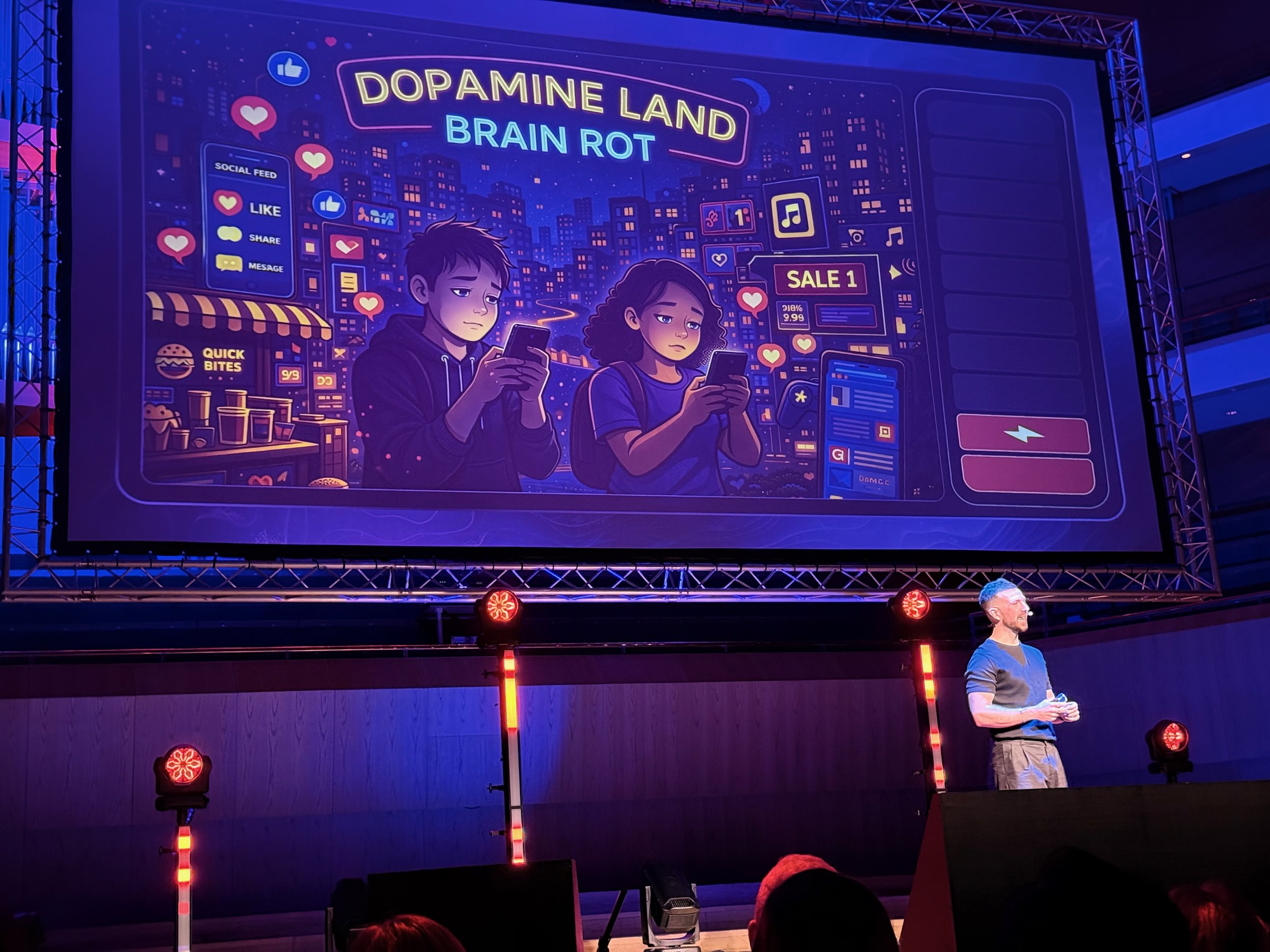
TJ’s talk on brain health and dopamine came with one of the most striking slides of the day: “Dopamine Land — Brain Rot.” Two teenagers staring blankly at their screens, surrounded by likes, notifications, and sale alerts, while the world dissolves into blue light around them.
It’s a brutal image. And it’s accurate.
The neuroscience here isn’t complicated: our phones are engineered to exploit the same reward loops that casinos use. Short hits of dopamine, variable rewards, infinite scroll. We’ve handed an entire generation — including mine — a slot machine and called it communication.
What TJ offered wasn’t doom, though. It was practical. Small, brain-based shifts that give you back some agency. Because the answer isn’t to throw your phone into the Bridgewater Canal. It’s to understand what’s happening neurologically and make deliberate choices accordingly.
As someone who works in UX and designs digital products for a living, I’ll be honest: this talk was a bit of an uncomfortable mirror. The same persuasion patterns we discuss academically as “engagement” are the same ones TJ was holding up as a public health concern. Worth sitting with.
Chris Bailey at TEDx Manchester
Chris Bailey — Are you actually playing the right game?
Chris Bailey had the most conceptually playful talk of the day, and probably the one I’ve thought about most since.
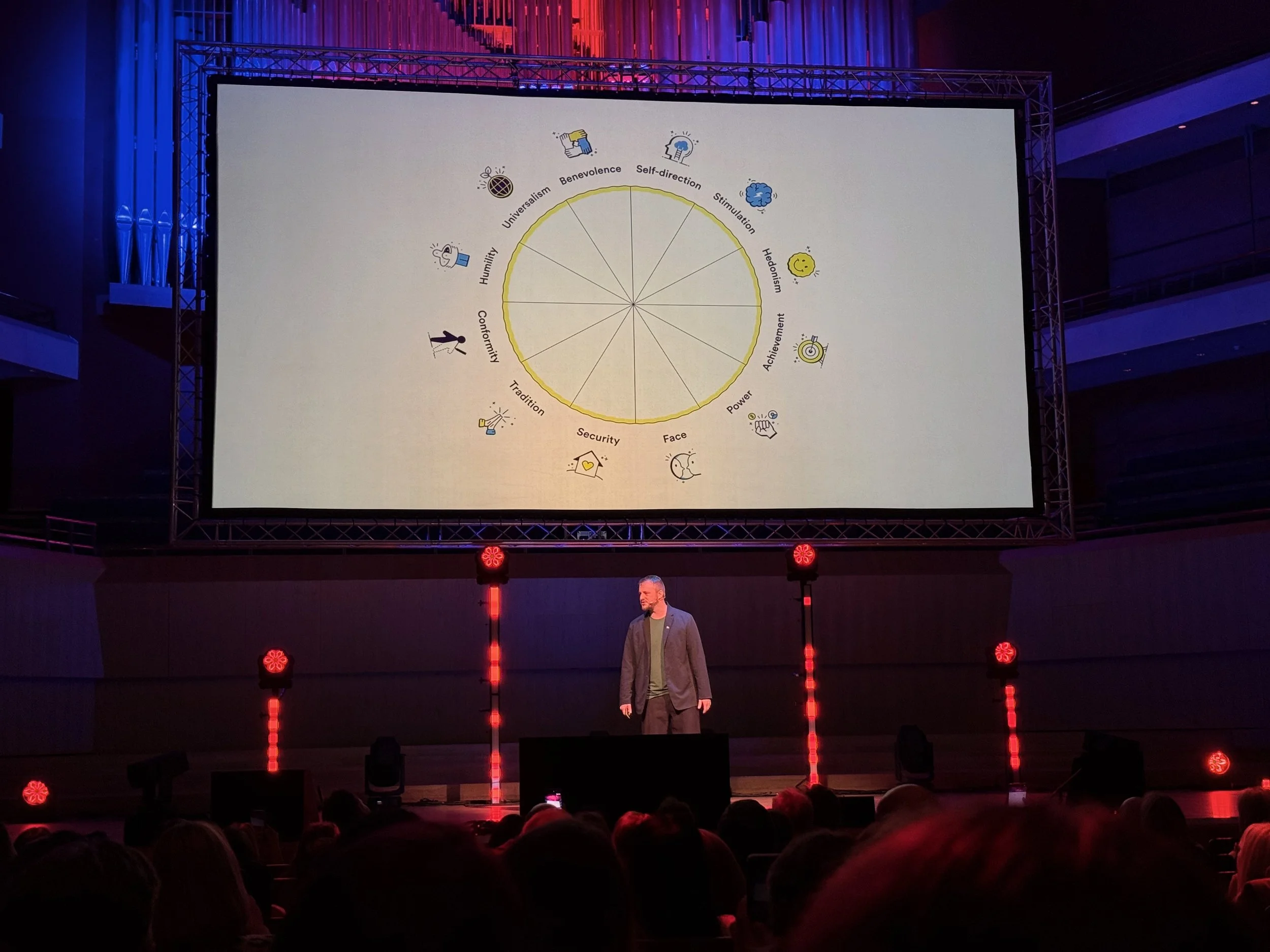
He walked through 12 core human values — things like achievement, security, benevolence, self-direction, hedonism — and ran the audience through a version of “Would You Rather” to understand which ones actually drive us. Not which ones we say drive us in job interviews, but which ones genuinely shape our decisions when nobody’s watching.
The insight was sharp: most of us are playing a game we didn’t consciously choose. We’ve inherited values from upbringing, culture, and circumstance, and then wonder why we feel vaguely unfulfilled even when we’re “succeeding.”
Chris’s point was that intentionality — real intentionality, not the Instagram kind — means understanding your actual value system and then designing your life around it. Not optimising for someone else’s definition of winning.
I come back to this a lot in my own work. Design that doesn’t start with genuine understanding of what people actually value is just decoration. It might look right. It might even test well. But it won’t stick because it’s solving for the wrong thing.
Know what your users actually value. Know what you actually value. Then build accordingly.
Michael Woolridge at TEDx Manchester
Prof Michael Wooldridge — AI’s longest-running hype cycle, explained by someone who was there for all of it
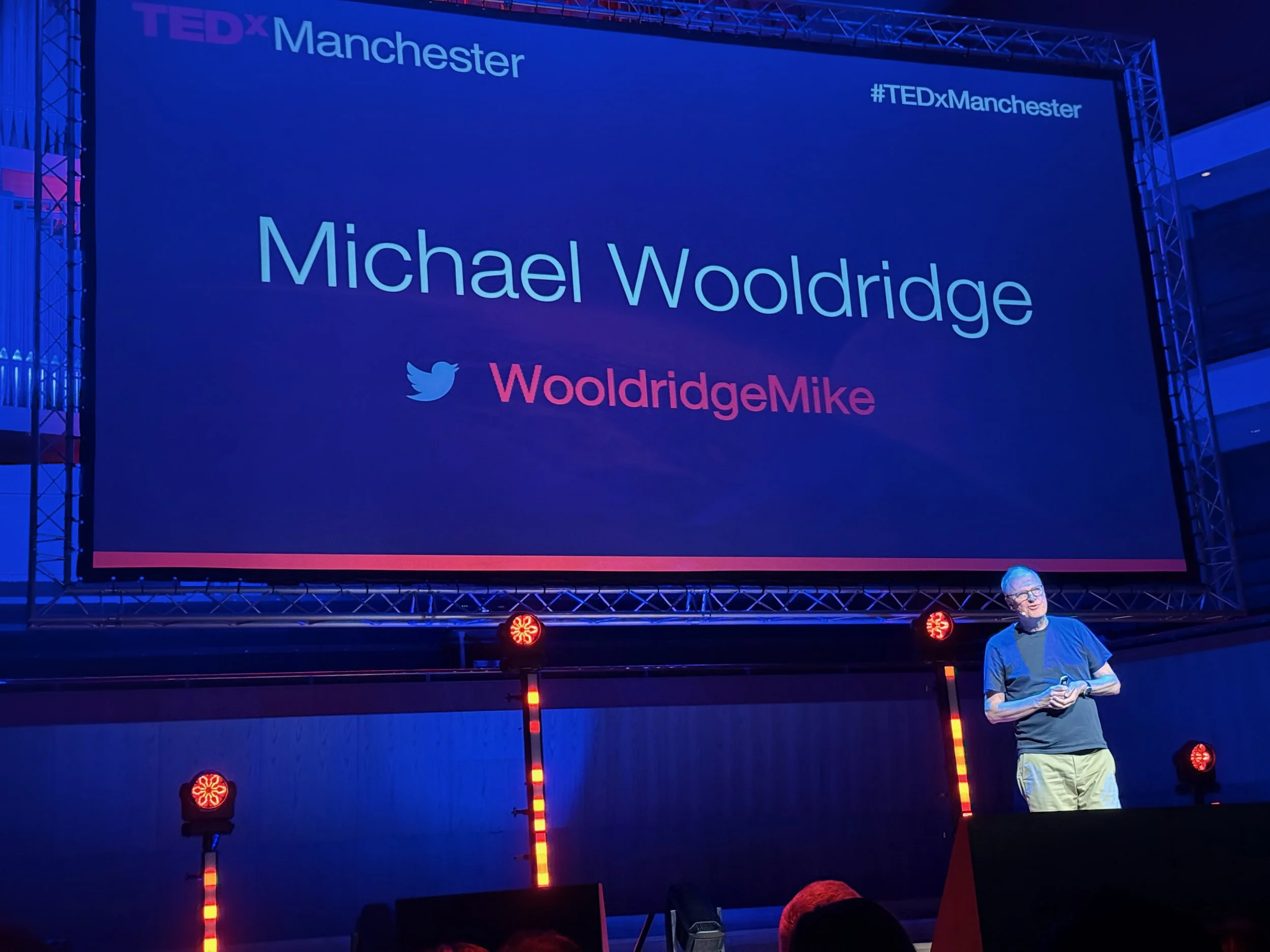
I’ll be upfront: I came into Prof Wooldridge’s talk expecting something forward-looking. An Oxford AI researcher on the TEDxManchester stage — surely this was going to be about what’s coming next?
It wasn’t, really. And that turned out to be the point.
His talk spent most of its time on the history of AI — the waves of excitement, the winters, the promises that didn’t land, the breakthroughs that eventually did. Less “here’s where we’re headed” and more “here’s how many times we’ve been here before.”
Which, if you think about it, is actually the more useful framing right now.
We’re in a moment where everyone has an opinion on AI and most of those opinions are about six months old. The breathless predictions, the catastrophising, the “this changes everything” hot takes — Wooldridge’s historical lens was a quiet corrective. AI has been both overhyped and underestimated repeatedly throughout its life. The pattern repeats. The technology moves slowly, then suddenly, then slowly again.
What I took from it: the people who’ll navigate this well aren’t the ones riding the hype. They’re the ones who understand the shape of the curve well enough to not be surprised by either end of it.
That’s the work. Understanding the thing well enough to use it well — not just to talk about it.
Jill Scott at TEDx Manchester
What I took away
(beyond the aching back from seven hours of auditorium seating)
TEDx Manchester is one of the top 20 TEDx events in the world. That’s not marketing fluff — you feel it. The curation is genuinely different. These aren’t speakers who read from slides. These are people who’ve done the work, thought hard about it, and found a way to put it into eighteen minutes without it feeling rushed or reductive.
The throughline across the whole day — even though the topics ranged from neuroscience to ancient Pompeii to AI to football — was something like this: most of us are sleepwalking through choices we didn’t consciously make, in environments designed to distract us, using habits we’ve never examined.
The antidote isn’t a productivity system. It’s attention. Real, deliberate, conscious attention. To what you’re listening to. To what your brain is being fed. To what you actually value.
If this resonated, come and have a look at what we’re building at designedforhumans.tech — a consultancy built around making digital experiences genuinely work for the humans using them. And if you work with design and engineering teams, take a look at tokens.designedforhumans.tech — we’re cutting weeks off the design-to-development handover, and it’s already changing how teams work.
Paul Wilshaw is the founder of Designed for Humans and Creator and Founder of systems.designedforhumans.ai. He speaks, writes, and consults on UX, AI, and the messy overlap between the two.
#TEDxManchester #DesignedForHumans #UX #AIDesign #DesignLeadership